Keywords
- Cholesterol
- Plant sterol
- Lipoproteins
- NPCIL1
- ABCG5/8
- ACAT2
Summary
The most common cause of death in the world today is heart disease due to atherosclerosis. Atherosclerosis is a disease where plaque buildup of fat, calcium, and cholesterol appear in the arteries. Cholesterol is a sterol that the body regularly produces to reduce fluidity in cell membranes. Humans do not only produce cholesterol but also consume it through different types of food. The cell’s intake of cholesterol can be modified with plant sterol intake. Plant sterols are sterols that are usually found in edible vegetation and nuts. In a time where food is unlimited and cardiovascular disease is prevalent, it is crucial to understand the potential of preventing this disease through nutrition.
Cholesterol Definition and Types
Cholesterol is a vital compound in the synthesis of bile acid, adrenal, and gonadal steroid hormones (Soliman, 2018). Most cholesterol is made in the liver, while the rest comes from food (Huff & Jialal, 2020). Since cholesterol is a hydrophobic compound and does not dissolve in blood, lipoprotein carriers are needed to carry cholesterol in the blood. There are 4 types of lipoprotein carriers. High density lipoprotein is considered the good type of lipoprotein because it allows the body to get rid of excess cholesterol from the peripheral vessel through the liver (Kosmas et al., 2018). Intermediate density lipoprotein, similar to low density lipoprotein, transports cholesterol from the liver to fatty acid consuming tissues through the blood (Norrington & Christophides, 2020). LDL cholesterol is a carrier that moves cholesterol to walls of different arteries in the tissues of the body (Pirahanchi & Huecker, 2020). Very low density lipoprotein carries a high density of cholesterol from the liver to muscle and adipose tissue (Caballero et al., 2003). These lipoproteins are crucial for the transport of cholesterol to avoid toxicity (Feingold & Grunfeld, 2018). Having large amounts of LDL cholesterol and low amounts of HDL cholesterol is dangerous because an excessive amount of cholesterol is being taken into the tissues, and not enough is eliminated from the liver. Excessive cholesterol is described as LDL cholesterol larger than 160mg/dL with a significant risk factor or LDL cholesterol more than 130 mg/dL with 2 major risk factors (Ibrahim & Jialal, 2020). Risk factors include diet, smoking, hypertension, age, and low HDL cholesterol (Ibrahim & Jialal, 2020). These Lipoprotein levels mainly depend on the makeup of a person’s genes and their diet. People with an excessive amount of cholesterol buildup in their bodies are diagnosed with hypercholesterolemia, which can eventually cause atherosclerosis (JV, 2020). Another main issue with excessive cholesterol being stored in the tissue is a heart attack and heart stroke; Therefore, many studies focus on decreasing the amounts of LDL cholesterol in patients who are at risk of atherosclerosis. Researchers have found that the consumption of plant sterols aids in the reduction of LDL cholesterol levels.
Plant Sterol vs. Cholesterol
Plant sterols, also known as phytosterols, are sterols that are present in plants like nuts, fruits, and vegetables and oil extracted from plant sources (Ras, Geleijnse and Trautwein, 2014). Plant sterols have similar hydrophobic chemical structures to cholesterol (Berger, Jones and Abumweis, 2004). Additionally, Phytosterols have a similar function to cholesterol in human cells (Gylling & Simonen, 2015). Many recent studies have found that these chemical structure similarities make phytosterols potential reducers of cholesterol by mimicking them in the body. Studies show that phytosterols block the gastrointestinal tract from absorbing cholesterol by competing with cholesterol to enter (Chen Y, 2020). Furthermore, plant sterols also compete with cholesterol in reacting with liver X receptors, which are receptors that limit cholesterol intake to achieve homeostasis when cholesterol levels are high.
Plant Sterol and Cholesterol Chemical Structures

Phytosterols are found in plant cell membranes, and they include plant sterols and plant stanols. Unsaturated Plant sterols have a higher degree of absorption than saturated plant stanols; Therefore, they are more abundant in food (Law, 2000). Studies show that plant sterols and plant stanols have similar effects in manipulating LDL cholesterol levels (Trautwein, Vermeer, Hiemstra & Ras, 2018). Thus, both are usually referred to as phytosterols. Some major phytosterols include Campesterol, Sitosterol, and stigmasterol. The chemical structure of these plant sterols is included in figure 1. These plant sterols have the same steroid skeleton as cholesterol. Some markers of cholesterol synthesis are cholesterol derivatives like desmosterol, lathosterol, and lanosterol (Trautwein et al., 2018). Cholesterol exists in 4 phases, High-density lipoprotein, intermediate-density lipoprotein, low-density lipoprotein, and finally, very low-density lipoprotein. These all have the same structure, but the different names indicate different transport routes. Figure 1 presents how cholesterol and plant sterols have very similar chemical hydrophobic structures, but plant sterols are more hydrophobic due to their slightly more complex structure. Plant sterols are more energetically favored because they are more hydrophobic (Scolaro, Andrade & Castro, 2019). Consequently, they displace cholesterol from the mixed micelle and reduce the amount of cholesterol entry into the intestine (Scolaro, Andrade & Castro, 2019. This study will investigate the mechanism of plant sterol in the body and how it may affect cholesterol levels. Additionally, different primary research findings will be revealed and compared.
Plant Sterol Mechanism
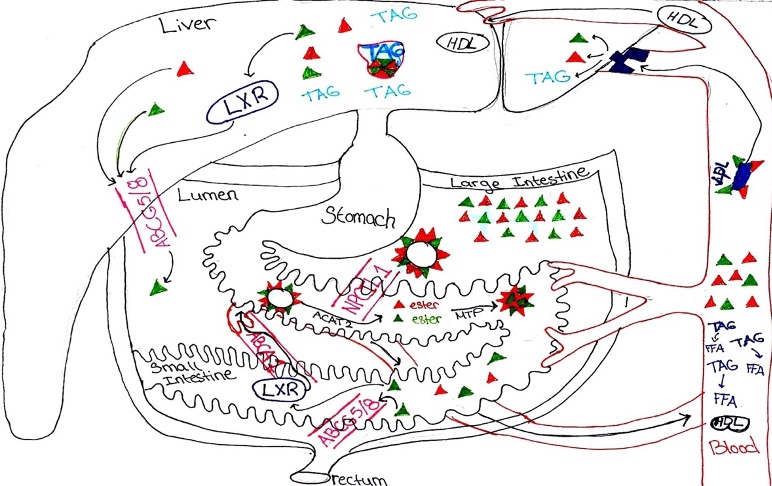

As plant sterols enters the human system, they are considered free sterols hovering around the intestinal lumen along with cholesterol and other molecules. Bile salt micelles float around the intestinal lumen collecting cholesterol (Scolaro, Andrade and Castro, 2019). The structural similarity of cholesterol and plant sterol allows PS to displace cholesterol from the micelle due to its limited capacity for sterols (Trautwein et al., 2018). Due to the PS’s hydrophobic properties, it is attracted to the micelle more than cholesterol (Dumolt and Rideout, 2018). PS and cholesterol must go through the brush border to enter the intestine. Their only means of transport into the intestine is the micelle. The micellecan only enter the brush border through the NPCIL1 transport protein. Cholesterol left in the lumen is removed through feces (Dumolt and Rideout, 2018). ACAT2 and MTP then package the cholesterol and PS into chylomicrons to be transported to the blood (Smet, Mensink and Plat, 2012). Unpackaged cholesterol can be moved back to the lumen by a transporter called ABCG5/8. Therefore, high plant sterol in the lumen has a decreasing domino effect on the upcoming pathways. First, PS decreases cholesterol being packaged in the chylomicron, which decreases MTP and ACAT2 produced; Eventually, decreasing TAG and cholesterol in blood circulation (Dumolt and Rideout, 2018). Chylomicrons are moved through the blood, to the ApoE receptor, and broken down into cholesterol, PS, and TAG in the liver (Scolaro, Andrade and Castro, 2019). These compounds then create VLDL and LDL, which enter the tissue through LDL receptors. HDL can prevent the fatty streaks from LDL accumulating in tissue by eliminating LDL. Additionally, PS activates liver X receptor (LXR), which are receptors that activate ABCG5/8 proteins that transport cholesterol back to the lumen (M, 2020). LXR’s are heterodimers that are activated by ligands like cholesterol or plant sterols (Plat et al., 2020). They come in alpha and beta isoforms; This complex regulates gene expression involved in cholesterol intake by activation of ABCG5/8 proteins (Malhotra & Alrefai, 2020). Not only is the LXR found in the liver, but it also works in the intestine by excreting excess cholesterol through the ABCG5/8 protein.
Primary Study Results
Primary studies summarized in Figure 5 show the effect of plant sterol intake on plasma cholesterol levels in the human body.
| Study | Subjects | PS intake | Duration of use | TC reduction | LDL C reduction |
| (Racette et al., 2009) | 18 | 2.4 g/day | 4 weeks | 10-25% | 8.9% |
| (Myrie, Mymin, Triggs-Raine and Jones, 2012) | 15 | 1.6 g/day | 4 weeks | 5.8 ± 1.4% | 9.6 ± 3.2% |
| (Mensink et al., 2010) | 131113 | 3 g/day6 g/day9g/day | 4 weeks | N/A | 7.4% 4.5% 17.4% |
| (Ras et al., 2015) | 199 | 3 g/day | 4 weeks | 6.7% | 6.7% |
| (Cheung et al., 2017) | 167 | 1.5g | 3 weeks | N/A | 4.58% |
All the studies in Figure 3 had a control group that took placebos instead of phytosterols. The most adequate research is the one done by Ras. Since Ras’s study has been done on the greatest number of subjects, the results are more reliable. Plant sterols can limit the intake of cholesterol by competing with cholesterol to enter the liver. This competition gives cholesterol less advantage to make it through the cell and into the blood. PS has been proven to decrease total cholesterol and LDL cholesterol levels since the early 1950s (Dumolt and Rideout, 2018). These studies show an average decrease of about 6.7% – 9.6% decrease in LDL cholesterol levels when about 1.6g – 3g of PS are consumed per day for at least 4 weeks. The most recent study, done by Cheung in 2017, concludes that the consumption of 1.5g of plant sterol for at least 3 weeks can decrease LDL cholesterol up 4.58% (Cheung et al., 2017). This study is only done for 3 weeks; Therefore, it shows the least amount of cholesterol reduction in comparison to all the other studies in Figure 3 that have tested plant sterols consumption for 4 weeks. Menskin’s study adds an additional conclusion regarding the relationship between plant sterols and cholesterol that is dose dependent. In this study a linear relationship is observed between grams of plant sterol intake and cholesterol LDL reduction (Mensink et al., 2010). As phytosterol intake was increased to 9g, LDL cholesterol in people was reduced 17.4% (Mensink et al., 2010). Another research shows very similar results, after a study done with 49 subjects experimenting the effect of 8.8g of plant sterol, 17.1% decrease was observed in LDL cholesterol (Gylling et al., 2010). Most studies focus on 2 – 3g of plant sterol intake per day because in most of the studies, there seems to be no further decrease in cholesterol levels after 3g/day(Laitinen & Gylling, 2012). The total cholesterol levels in the body depend on amounts of LDL cholesterol and HDL cholesterol. Menskin’s studied showed no difference in HDL cholesterol before and after the intake of plant sterol; therefore, decrease in total cholesterol levels was not discussed heavily (Mensink et al., 2010). This study requires the patients to eat specific types of food which are high in fat and that may negatively affect the experiment. Results of such studies need to be interpreted with care as confounding factors may still affect these studies like type of diet patients were prescribed and adhere to.
Phytosterols are good manipulators of body cholesterol levels
Phytosterols are efficient LDL cholesterol reducers in the body. Many primary research articles have shown that plant sterols can affect cholesterol levels in the intestine, and liver. These researches study subjects that are given plant sterols with fat-based meals in order for the plant sterol to be effective in reducing cholesterol. Due to the need of a specific diet while taking the plant sterol might be another factor that affects the outcome of these studies (Trautwein et al., 2018). Overall, most of the studies show a decrease in LDL cholesterol after plant sterol intake. This decrease of cholesterol is supported by the mechanism of plant sterol in the liver and intestine. Once plant sterols are in the lumen, they immediately become cholesterol competitors in their adhesion to the micelle. Only sterols attached to the micelle can enter the intestine and eventually go to the blood and into other tissues. Cholesterol that isnt moved out of the lumen is excreted out of the body through the rectum. Therefore, the decrease in cholesterol is seen from the beginning of the mechanism, and once this is decreased everything else after that has less cholesterol than it usually does without PS in the system. Another path where phytosterol is greatly affective in decreasing cholesterol is in the intestine and in the liver where LXR’s exist. Studies show that plant sterols act as LXR activators when they are present (Plat et al., 2005). LXR is a great pathway for cholesterol excretion because once LXR is activated, it activates ABCG5/8 which reduces cholesterol absorption by moving cholesterol from tissues to the lumen (Plat et al., 2005). These mechanisms support the studies that show a decrease in LDL total cholesterol levels when plant sterols are consumed. Overall, there is an inverse relationship between plant sterol levels and cholesterol levels in the tissue. Plant sterols can be an effective method in lowering blood cholesterol, especially in patients who have high LDL cholesterol in their bodies. A diet consisting of 2 – 3g of plant sterol per day may be helpful in significantly decreasing tissue cholesterol absorption, no additional benefit seems to be gained after 3 grams of phytosterol intake. Finally, phytosterols may be the solution for patients suffering from heart disease due to atherosclerosis, if more studies on phytosterol and atherosclerosis are conducted.
Concluding Remarks and Future Perspectives
More than 200 studies have found that 3g of plant sterol decreases the amount of LDL cholesterol around 10.7% in the body (Scolaro, Andrade and Castro, 2019). After consuming 3g of PS per day, studies have shown no additional change to occur after further intake (Demonty et al., 2008). A study shows that PS’s have a significant positive effect on cardiovascular disease since it has been proven to decrease LDL – cholesterol levels (Piepoli et al., 2016). Atherosclerosis is multifactorial and therefore, one cannot simply conclude that plant sterols can reduce atherosclerosis from the relationship between PS and LDL cholesterol. A huge gap in research exists in regard to the effect of plant sterols on children and infants (Scolaro, Andrade and Castro, 2019).
Highlights
- Low cholesterol absorption in the brush border has a domino effect in lowering levels of ACAT and MTP for the transport of cholesterol to blood, making less VLDL and LDL available for the tissue.
- Plant sterols have shown to decrease CD4/CD8 ratios and increasing C4+ and CD25+, resulting in anti-inflammatory effects (Plat et al., 2019).
- Plant sterols and stanols have been shown to increase in concentration after their consumption (Dumolt & Rideout, 2018)
- Studies found that after 2g of plant sterol intake, the body does not further respond to increased PS by lowering cholesterol further (Ravnskov et al., 2018).
- Different types of plant sterols are effective in different parts of the body. A study shows that campesterol access the brain more efficiently than sitosterol (Vanmierlo et al., 2012).
Clinicians Corner (200 – 400)
It is vital to understand that plant sterols may have adverse effects on infants (Plat et al., 2019). A pregnant woman needs to have reasonable amounts of cholesterol circulating their body because cholesterol is vital for a newborn’s cell synthesis. Therefore, sufficient amounts of cholesterol need to exist in the mother’s body, including her breast milk.
Future studies can look into the effects of PS on vitamin absorption. A few studies show that fat-soluble vitamins are decreased with the consumption of phytosterol because the lipoproteins that carry fat-soluble vitamins are not activated during a lack of sufficient cholesterol in the body (C. Maki, 2015).
In the researches done previously, phytosterols are usually taken with large meals to make sure a good amount of bile acid is secreted. Preparing specific meals may increase or decrease the subject’s cholesterol intake, depending on their usual daily diet. The decrease in cholesterol levels may be due to the type of food being eaten by the studied subjects. Potential strategies to prevent uncertainty could be done with minimal food control to test the effect of phytosterol on cholesterol levels.
References
Soliman, G. (2018). Dietary Cholesterol and the Lack of Evidence in Cardiovascular Disease. Nutrients, 10(6), 780. https://doi.org/10.3390/nu10060780
Huff, T., & Jialal, I. (2020). Physiology, Cholesterol. Retrieved 20 April 2020, from https://www.ncbi.nlm.nih.gov/books/NBK470561/
Feingold, K., & Grunfeld, C. (2018). Introduction to Lipids and Lipoproteins. Retrieved 20 April 2020, from https://www.ncbi.nlm.nih.gov/books/NBK305896/
Kosmas, C., Martinez, I., Sourlas, A., Bouza, K., Campos, F., & Torres, V. et al. (2018). High-density lipoprotein (HDL) functionality and its relevance to atherosclerotic cardiovascular disease. Drugs In Context, 7(212525), 1-9. https://doi.org/10.7573/dic.212525
Venugopal, S., & Jialal, I. (2020). Biochemistry, Low Density Lipoprotein. Ncbi.nlm.nih.gov. Retrieved 18 April 2020, from https://www.ncbi.nlm.nih.gov/books/NBK500010/.
Pirahanchi, Y., & Huecker, M. (2020). Biochemistry, LDL Cholesterol. Ncbi.nlm.nih.gov. Retrieved 18 April 2020, from https://www.ncbi.nlm.nih.gov/books/NBK519561/.
Caballero, B., Trugo, L., & Finglas, P. (2003). Encyclopedia of food sciences and nutrition (2nd ed., p. 3183). Academic Press.
JV, J. (2020). Mechanisms of hypercholesterolemia and atherosclerosis. – PubMed – NCBI. Ncbi.nlm.nih.gov. Retrieved 4 April 2020, from https://www.ncbi.nlm.nih.gov/pubmed/3389027.
Ras, R., Geleijnse, J., & Trautwein, E. (2014). LDL-cholesterol-lowering effect of plant sterols and stanols across different dose ranges: a meta-analysis of randomised controlled studies. British Journal Of Nutrition, 112(2), 214-219. https://doi.org/10.1017/s0007114514000750
Berger, A., Jones, P., & Abumweis, S. (2004). Lipids In Health And Disease, 3(1), 5. https://doi.org/10.1186/1476-511x-3-5
Chen, Y., She, Y., Kaur, R., Guo, N., Zhang, X., Zhang, R., & Gou, X. (2019). Is Plant Sterols a Good Strategy to Lower Cholesterol?. Journal Of Oleo Science, 68(9), 811-816. https://doi.org/10.5650/jos.ess19116
Scolaro, B., Andrade, L., & Castro, I. (2019). Cardiovascular Disease Prevention: The Earlier the Better? A Review of Plant Sterol Metabolism and Implications of Childhood Supplementation. International Journal Of Molecular Sciences, 21(1), 128. https://doi.org/10.3390/ijms21010128
Ras, R., Fuchs, D., Koppenol, W., Schalkwijk, C., Otten-Hofman, A., & Garczarek, U. et al. (2016). Effect of a plant sterol-enriched spread on biomarkers of endothelial dysfunction and low-grade inflammation in hypercholesterolaemic subjects. Journal Of Nutritional Science, 5. https://doi.org/10.1017/jns.2016.40
Racette, S., Lin, X., Lefevre, M., Spearie, C., Most, M., Ma, L., & Ostlund, R. (2009). Dose effects of dietary phytosterols on cholesterol metabolism: a controlled feeding study. The American Journal Of Clinical Nutrition, 91(1), 32-38. https://doi.org/10.3945/ajcn.2009.28070
Myrie, S., Mymin, D., Triggs-Raine, B., & Jones, P. (2012). Serum lipids, plant sterols, and cholesterol kinetic responses to plant sterol supplementation in phytosterolemia heterozygotes and control individuals. The American Journal Of Clinical Nutrition, 95(4), 837-844. https://doi.org/10.3945/ajcn.111.028985
Mensink, R., de Jong, A., Lütjohann, D., Haenen, G., & Plat, J. (2010). Plant stanols dose-dependently decrease LDL-cholesterol concentrations, but not cholesterol-standardized fat-soluble antioxidant concentrations, at intakes up to 9 g/d. The American Journal Of Clinical Nutrition, 92(1), 24-33. https://doi.org/10.3945/ajcn.2009.29143
Ras, R., Fuchs, D., Koppenol, W., Garczarek, U., Greyling, A., & Keicher, C. et al. (2015). The effect of a low-fat spread with added plant sterols on vascular function markers: results of the Investigating Vascular Function Effects of Plant Sterols (INVEST) study. The American Journal Of Clinical Nutrition, 101(4), 733-741. https://doi.org/10.3945/ajcn.114.102053
Smet, E., Mensink, R., & Plat, J. (2012). Effects of plant sterols and stanols on intestinal cholesterol metabolism: Suggested mechanisms from past to present. Molecular Nutrition & Food Research, 56(7), 1058-1072. https://doi.org/10.1002/mnfr.201100722
Dumolt, J., & Rideout, T. (2018). The Lipid-lowering Effects and Associated Mechanisms of Dietary Phytosterol Supplementation. Current Pharmaceutical Design, 23(34). https://doi.org/10.2174/1381612823666170725142337
M, B. (2008). Biological role of liver X receptors. – PubMed – NCBI. Ncbi.nlm.nih.gov. Retrieved 5 April 2020, from https://www.ncbi.nlm.nih.gov/pubmed/19258656.
Plat, J., Baumgartner, S., Vanmierlo, T., Lütjohann, D., Calkins, K., & Burrin, D. et al. (2019). Plant-based sterols and stanols in health & disease: “Consequences of human development in a plant-based environment?”. Progress In Lipid Research, 74, 87-102. https://doi.org/10.1016/j.plipres.2019.02.003
Ravnskov, U., de Lorgeril, M., Diamond, D., Hama, R., Hamazaki, T., & Hammarskjöld, B. et al. (2018). LDL-C does not cause cardiovascular disease: a comprehensive review of the current literature. Expert Review Of Clinical Pharmacology, 11(10), 959-970. https://doi.org/10.1080/17512433.2018.1519391
Vanmierlo, T., Weingärtner, O., van der Pol, S., Husche, C., Kerksiek, A., & Friedrichs, S. et al. (2012). Dietary intake of plant sterols stably increases plant sterol levels in the murine brain. Journal Of Lipid Research, 53(4), 726-735. https://doi.org/10.1194/jlr.m017244
C. Maki,, K. (2015). Phytosterols for lowering cholesterol: pharmacy interventions to improve patient outcomes. Go-gale-com.salford.idm.oclc.org. Retrieved 21 October 2015, from https://go-gale-com.salford.idm.oclc.org/ps/i.do?id=GALE%7CA435633718&v=2.1&u=salcal2&it=r&p=AONE&sw=w.
Ottestad, I., Ose, L., Wennersberg, M., Granlund, L., Kirkhus, B., & Retterstøl, K. (2013). Phytosterol capsules and serum cholesterol in hypercholesterolemia: A randomized controlled trial. Atherosclerosis, 228(2), 421-425. https://doi.org/10.1016/j.atherosclerosis.2013.03.001
Demonty, I., Ras, R., van der Knaap, H., Duchateau, G., Meijer, L., & Zock, P. et al. (2008). Continuous Dose-Response Relationship of the LDL-Cholesterol–Lowering Effect of Phytosterol Intake. The Journal Of Nutrition, 139(2), 271-284. https://doi.org/10.3945/jn.108.095125
Piepoli, M., Hoes, A., Agewall, S., Albus, C., Brotons, C., & Catapano, A. et al. (2016). 2016 European Guidelines on cardiovascular disease prevention in clinical practice. European Heart Journal, 37(29), 2315-2381. https://doi.org/10.1093/eurheartj/ehw106
He, W., Zhu, H., & Chen, Z. (2018). Plant Sterols: Chemical and Enzymatic Structural Modifications and Effects on Their Cholesterol-Lowering Activity. Journal Of Agricultural And Food Chemistry, 66(12), 3047-3062. https://doi.org/10.1021/acs.jafc.8b00059
Trautwein, E., Vermeer, M., Hiemstra, H., & Ras, R. (2018). LDL-Cholesterol Lowering of Plant Sterols and Stanols—Which Factors Influence Their Efficacy?. Nutrients, 10(9), 1262. https://doi.org/10.3390/nu10091262
Malhotra, P., & Alrefai, W. (2020). Liver X Receptor – an overview | ScienceDirect Topics. Sciencedirect.com. Retrieved 30 March 2020, from https://www.sciencedirect.com/topics/neuroscience/liver-x-receptor.
Cholesterol. Pubchem.ncbi.nlm.nih.gov. (2020). Retrieved 3 April 2020, from https://pubchem.ncbi.nlm.nih.gov/compound/Cholesterol.
Trautwein, E., Koppenol, W., de Jong, A., Hiemstra, H., Vermeer, M., Noakes, M., & Luscombe-Marsh, N. (2018). Plant sterols lower LDL-cholesterol and triglycerides in dyslipidemic individuals with or at risk of developing type 2 diabetes; a randomized, double-blind, placebo-controlled study. Nutrition & Diabetes, 8(1).https://doi.org/10.1038/s41387-018-0039-8
Gylling, H., Hallikainen, M., Nissinen, M., & Miettinen, T. (2010). The effect of a very high daily plant stanol ester intake on serum lipids, carotenoids, and fat-soluble vitamins. Clinical Nutrition, 29(1), 112-118. https://doi.org/10.1016/j.clnu.2009.08.005
Talati, R., Sobieraj, D., Makanji, S., Phung, O., & Coleman, C. (2010). The Comparative Efficacy of Plant Sterols and Stanols on Serum Lipids: A Systematic Review and Meta-Analysis. Journal Of The American Dietetic Association, 110(5), 719-726. https://doi.org/10.1016/j.jada.2010.02.011
Laitinen, K., & Gylling, H. (2012). Dose-dependent LDL-cholesterol lowering effect by plant stanol ester consumption: clinical evidence. Lipids In Health And Disease, 11(1). https://doi.org/10.1186/1476-511x-11-140
Plat, J., Nichols, J., & Mensink, R. (2005). Plant sterols and stanols: effects on mixed micellar composition and LXR (target gene) activation. Journal Of Lipid Research, 46(11), 2468-2476. https://doi.org/10.1194/jlr.m500272-jlr200
Ibrahim, M., & Jialal, I. (2020). Hypercholesterolemia. Retrieved 20 April 2020, from https://www.ncbi.nlm.nih.gov/books/NBK459188/
Law, M. (2000). Plant sterol and stanol margarines and health. BMJ, 320(7238), 861-864. doi: 10.1136/bmj.320.7238.861
Cheung, C., Ho, D., Sing, C., Tsoi, M., Cheng, V., & Lee, G. et al. (2017). Randomized controlled trial of the effect of phytosterols-enriched low-fat milk on lipid profile in Chinese. Scientific Reports, 7(1). doi: 10.1038/srep41084
Gylling, H., & Simonen, P. (2015). Phytosterols, Phytostanols, and Lipoprotein Metabolism. Nutrients, 7(9), 7965-7977. doi: 10.3390/nu7095374
 Contemporary Science